Episode Transcript
[00:00:16] Speaker B: Yeah, we really like to work with our friends, and most people we work with, especially in the key roles, are just people that we are friends with in real life, which we think are so, so talented and just love being around.
[00:00:29] Speaker C: I feel like every film set has to be at least 51% summer camp and then 49% film production.
[00:00:35] Speaker D: Yeah, that's true.
[00:00:36] Speaker C: It has to be.
[00:00:39] Speaker D: I'm Luke Steinfeld.
[00:00:40] Speaker A: And I'm Wyatt Sarkissian.
[00:00:41] Speaker D: We made the 5050 podcast to support you on your filmmaking journey.
[00:00:45] Speaker A: 50% business, 50% creative.
[00:00:47] Speaker D: Every Tuesday, a new how to.
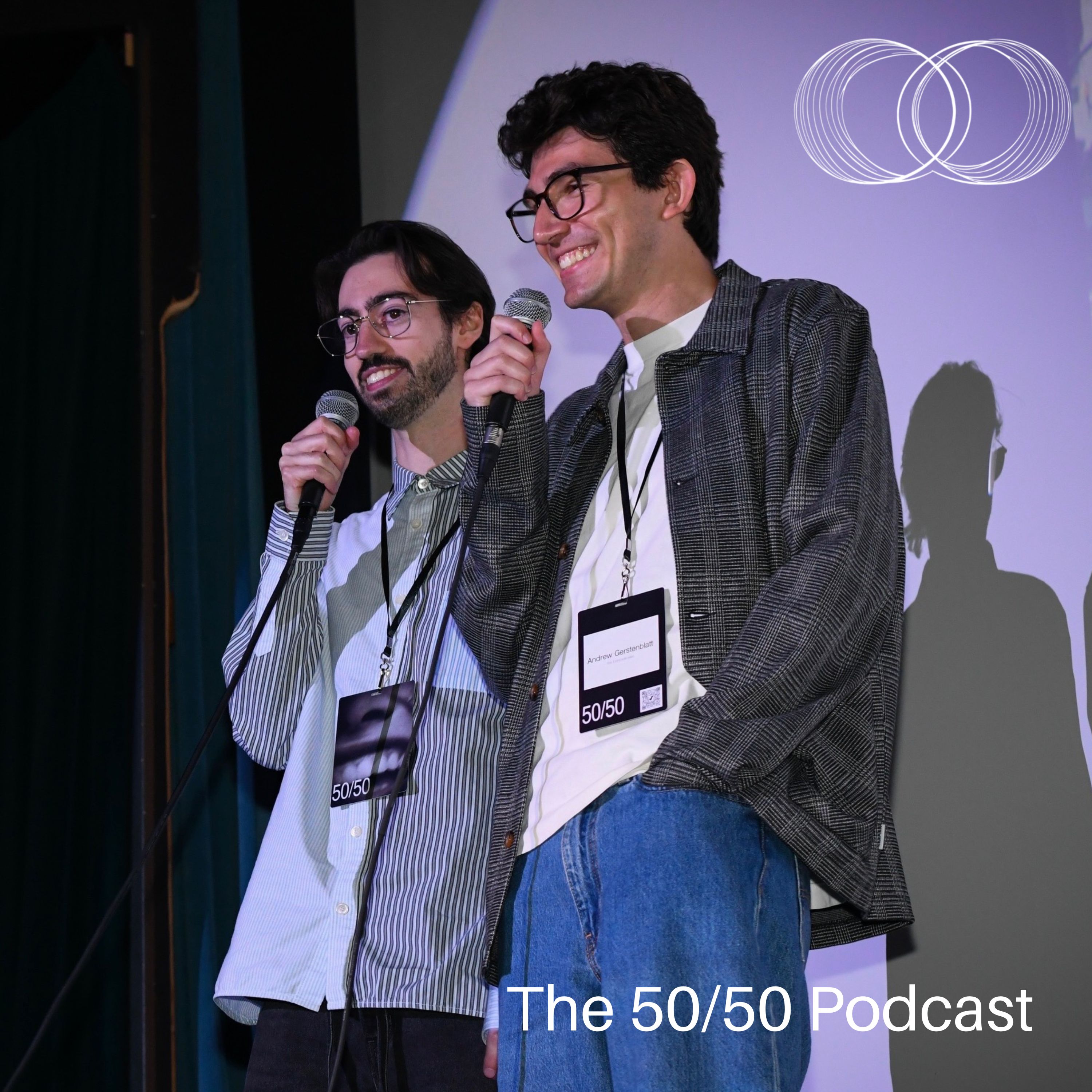
[00:00:49] Speaker A: This week, it's Ag Squared. That's right. Filmmaking duo Andrew Gerstenblatt and Arthur Goldbart are on the show.
Or back on the show, should I say. It should be mentioned that not only are these guys our first repeat guests, but they're foundational to the DNA of the 5050 festival itself. Our longtime pals discussed their newest short, the Extraordinaries, which not Only was a 5050 selectee, but is a true testament to their creative partnership, friendship, and marriage.
[00:01:23] Speaker C: Maybe.
[00:01:23] Speaker A: Are they getting married? Tune in to find out.
[00:01:36] Speaker D: You have. Is this your real handwriting? I decided, yeah, it is.
[00:01:39] Speaker A: It's my notepad.
[00:01:40] Speaker B: Wait, so when are we.
[00:01:41] Speaker C: I did some preparation.
[00:01:42] Speaker B: Are we gonna talk about Drake soon?
[00:01:44] Speaker C: Drake.
[00:01:45] Speaker A: Drake.
[00:01:45] Speaker B: Earlier or later in the fall?
[00:01:47] Speaker D: You can tell.
[00:01:48] Speaker C: Drake. Drake.
[00:01:49] Speaker B: Drake and driving.
[00:01:50] Speaker C: Drake and driving.
[00:01:50] Speaker B: Have you ever done a Drake and drive?
[00:01:52] Speaker C: Yeah.
[00:01:52] Speaker D: Drake and drive.
[00:01:52] Speaker C: Drake and drive. I don't know what is. Just listen to Drake while you drive.
[00:01:56] Speaker D: Oh, Drake and drive.
[00:01:58] Speaker A: It's kind of close to drink and drive, which is.
[00:02:00] Speaker B: Yeah, but it's way worse. Yeah, but, yeah, it's way more dangerous.
[00:02:03] Speaker C: A lot more dangerous.
[00:02:05] Speaker D: What were you guys doing that on the way here?
[00:02:06] Speaker C: We did it.
[00:02:07] Speaker A: Yeah.
[00:02:08] Speaker B: Taking your time.
[00:02:09] Speaker A: Can we talk about when you guys got here?
[00:02:11] Speaker C: Yeah, I know we were late.
[00:02:12] Speaker B: Yeah, we were.
[00:02:13] Speaker C: Shout out, Parker.
[00:02:14] Speaker A: Yeah.
[00:02:15] Speaker B: Yeah.
[00:02:15] Speaker D: Whoa.
[00:02:17] Speaker C: You can cut.
[00:02:17] Speaker D: Shut up.
[00:02:17] Speaker C: No, Parker's great.
[00:02:18] Speaker D: We can't cut. So this is
[00:02:21] Speaker B: cool.
[00:02:22] Speaker A: You actually can't cut or you can, but it looks a little.
[00:02:27] Speaker D: Yeah, really weird.
[00:02:28] Speaker B: So we should self censor ourselves.
[00:02:30] Speaker D: Absolutely.
[00:02:31] Speaker A: Yeah.
[00:02:32] Speaker C: Maybe we shouldn't talk about Drake then.
[00:02:34] Speaker B: Okay.
[00:02:35] Speaker D: I mean, if you want to talk
[00:02:36] Speaker B: about Drake, I mean, I'll let you guys do the interview.
[00:02:39] Speaker D: I. I love. I'm a.
Let's not talk about Drake.
[00:02:42] Speaker A: Yeah.
[00:02:45] Speaker B: Luke likes what Drake likes.
[00:02:47] Speaker D: We can't cut this.
[00:02:48] Speaker C: We just can't. Yeah, yeah, yeah.
[00:02:51] Speaker A: Well, I. I want to first talk about your partnership.
[00:02:54] Speaker B: It's a nice.
[00:02:55] Speaker A: I.
Yeah. And. And you guys are roommates.
[00:02:58] Speaker B: Yeah.
[00:02:58] Speaker A: And BFFs.
[00:03:00] Speaker C: True.
[00:03:01] Speaker A: And we've had both of you individually on the podcast and you've obviously talked about each other.
[00:03:05] Speaker B: Yes.
[00:03:07] Speaker A: But I want to kind of discuss what your creative partnership looks like through. Through this film, the extraordinaries. And if you want to just give like a one liner of what it's about.
[00:03:16] Speaker B: Yeah.
[00:03:17] Speaker A: And then talk about sort of the conception and we can go from there.
[00:03:20] Speaker B: What's it about?
[00:03:22] Speaker C: Well, it's about two guys who are on their way to a friend's wedding and they stop at an antique store to pick up a gift.
One of them is British, one of them is American.
[00:03:33] Speaker B: Guess which one.
[00:03:33] Speaker C: Guess which one. Yeah, exactly. And comment down below, guys.
And the British guy gets a phone call and unexpectedly changes everything. And hijinks ensue, as you could say. But it's written, directed, and stars the both of us. And it was made from a very real place last year.
And we kind of wanted to, like, return to our roots of doing something very homegrown and very like, you know, all of our friends are the crew one day, one location, stars the both of us, and, like, just try to do something fun for us.
[00:04:14] Speaker A: I feel like that's what people talk about. Right. Like, if we could just do like one location one day.
[00:04:19] Speaker D: Did it.
[00:04:19] Speaker A: You know, it's like, it's like the idealistic thing that a lot of filmmakers who are. Who feel like they can't get anything done, dream of doing, you know, and you guys did it, which is pretty amazing.
[00:04:30] Speaker D: And successfully doing that comes across. And we talk about it so much with, like, that calling card short, which is so important to have.
[00:04:40] Speaker C: I think it was. Yeah. It's fun that you mentioned that because it's like Arthur and I talk about our.
The things that we want to make all the time. And like, we're very happy that we made the extraordinaries because, one, we had, like, so much fun doing it. And it was just like, you know, it wasn't super complicated because we had a great team behind us.
[00:04:58] Speaker B: Yeah.
[00:04:58] Speaker C: But also it was like we kind of made the movie just for us so that we had, like, this time capsule movie that we could, like, go
[00:05:05] Speaker B: back to and experience and that you're proud Of.
[00:05:08] Speaker C: Yeah, we're proud of it.
[00:05:09] Speaker A: So proud of it.
[00:05:09] Speaker B: It's like an alternative reality. Well, like, I didn't get a visa and I didn't get sponsored. Like, what could have happened?
[00:05:15] Speaker D: Yeah.
[00:05:16] Speaker B: It's like, oh, based on my real conversations we have had just in our living room.
[00:05:19] Speaker C: Yes. Like, literally, we have.
[00:05:21] Speaker D: You feel that. You feel that. And I think a lot of times the best calling cards come from a very personal place.
[00:05:27] Speaker A: Totally.
[00:05:27] Speaker D: You know, and, like, it. It's so funny because it takes time to get there, to be able to do that and, like, go off and write something very personal or real. Cause you think you have to, like, oh, well, maybe a murderer, and then there's a bus, and then anything can
[00:05:42] Speaker A: be in a short.
[00:05:42] Speaker C: Yeah.
[00:05:43] Speaker A: So it's, like, hard to stay true and authentic to who you guys are in your partnership.
[00:05:48] Speaker D: But the simplicity of it and. And the realness, all of that come together, and just the fact that it's you guys, and naturally, you're very funny people, and there's.
[00:05:58] Speaker A: Clearly, you have that chemistry, you know, like, clearly you have that. Even, like, the. The dialogue was written, but it felt so natural.
[00:06:05] Speaker B: Yes.
[00:06:05] Speaker A: You know?
[00:06:05] Speaker C: Yeah.
[00:06:06] Speaker D: Were you guys messing around?
[00:06:07] Speaker A: I believe that.
[00:06:08] Speaker C: Yeah.
[00:06:08] Speaker B: A lot of it's improv.
[00:06:09] Speaker C: Yeah.
[00:06:09] Speaker B: And it's like. I don't know. We've lived together for five years. Yeah.
[00:06:14] Speaker D: How many shorts have you made together at this point?
[00:06:15] Speaker B: Two big.
[00:06:16] Speaker C: Two big ones.
[00:06:17] Speaker B: Bunch of sketches and a ton of, like, small ones.
[00:06:20] Speaker C: But we've been making, like. I wouldn't even try to put a number on it because it's like, we've been making little stuff.
[00:06:25] Speaker D: That's what I mean.
[00:06:26] Speaker C: Since film school.
[00:06:27] Speaker B: Yeah.
[00:06:27] Speaker C: Like, all the time.
[00:06:28] Speaker A: Yeah, totally. And the writing process, what does that look like?
[00:06:31] Speaker B: Yeah. Writing process. Depending on what it is. But, like, we're writing that short, for example. That was really quick. That was just, like, based on real conversations. We wrote in, like, a day, tweaked it a couple times, and then let it be kind of more fluid on set. But, like, if we're writing a movie, not like that, we, like, outline for, like, a year sometimes.
[00:06:54] Speaker D: So you didn't. You didn't outline this short?
[00:06:57] Speaker C: No, because it was just eight pages, you know, like, very. Just, like, natural. We kind of talked about it and knew what we wanted to put into it.
[00:07:05] Speaker A: Also, the simple. The simplicity of the plot sort of allows you to not need to actually, like, order out the plot points in
[00:07:12] Speaker C: the way that you would with a
[00:07:13] Speaker B: different kind of felt like what would be. You know, you Kind of sketch brain a little bit. Like, how can we escalate? What is the progression?
[00:07:21] Speaker A: Totally. And that's just like, in you guys at this point, to do that.
[00:07:23] Speaker B: Right. It's like, beginning, middle, end, abc, whatever, plot, payoff.
[00:07:29] Speaker D: What's the difference of a sketch versus a comedic short film?
[00:07:35] Speaker B: That's a good question.
I think a comedic short film, at least for us, is set more in reality. The rules are more, like, true to real life, whereas a sketch, you can kind of go off the edges and kind of, like, anything can happen.
And you do want to escalate in the craziest, funniest way, but you can. But it's like, we were talking about this recently, where it's like, even if we're kind of playing ourselves either short or versus a sketch, it's just like.
Like, Andrew could die and be dead for one second in a sketch and then come back to life the next second, and it would still work. Don't do that in a computer.
[00:08:13] Speaker A: It depends on, like, the world you're setting up. Is this a world where someone can
[00:08:16] Speaker C: die and come back to life right away?
And in the short, like, we. We try to stick to the same rules of storytelling as what we would do in a feature.
[00:08:24] Speaker B: Yeah.
[00:08:24] Speaker C: You know, whereas, like, sketch, Anything goes.
[00:08:27] Speaker D: As in you're thinking about an arc character. Yes.
[00:08:29] Speaker C: Thinking about plants, payoffs and arcs and change and growth and, like, you know, stuff that's a little more whole.
[00:08:36] Speaker B: Yeah.
[00:08:37] Speaker C: Tied up.
[00:08:38] Speaker B: Like, a short is kind of a sky, a circle, but a sketch is kind of a sketch.
[00:08:42] Speaker D: But I mean, even hearing that and, like, because Extraordinaries is a comedic short film, it's not a sketch.
[00:08:47] Speaker B: Right.
[00:08:48] Speaker D: And you're thinking feature mind. Like, we need these plants and these payoffs that comes from rewriting.
[00:08:54] Speaker B: Yes.
[00:08:55] Speaker D: I mean, if it's not outlining, it's rewriting.
[00:08:57] Speaker B: Yeah.
[00:08:58] Speaker D: Unless you're just so in it that you're like, well, we'll plant this here and pay off the page eight, Right.
[00:09:03] Speaker B: Yeah.
[00:09:03] Speaker D: It's like, so did you guys. You wrote it in a day, but were you rewriting for months? Were you? Or was it really just short?
[00:09:09] Speaker C: Yeah, no, we wrote it in a day and then, like, you know, I think sent it to our producers, who gave us, like, a couple thoughts and notes. We tweaked it from there, and that was kind of it. But then it changed on the day.
[00:09:22] Speaker D: How?
[00:09:23] Speaker A: Not. Not plot wise. No, not plot wise in terms of dialogue.
[00:09:27] Speaker C: Yeah.
[00:09:27] Speaker B: I mean, I think I spoke about this in my first podcast, but it's kind of about like the onset magic.
[00:09:32] Speaker D: Find the funny.
[00:09:32] Speaker B: Find the funny. Remember that? And it's kind of just like we wanted the extraordinaries to be funny, but we wanted it to be like wholesome and sweet and have a drama and stakes to it too.
[00:09:45] Speaker A: And it definitely showed.
[00:09:46] Speaker B: And it's like we definitely focused on that when we were doing. When we were writing the script. And then when we got in there we were like, well, how do we find the funny more? And so we were improvising different lines and cutting in. Like it's a whole bit. We do like forget about it.
[00:10:04] Speaker C: Yeah, that was improv. And that's like a plant and path that people.
[00:10:07] Speaker A: Yeah, I was gonna say it feels very written because it has that sort of plant payoff.
[00:10:11] Speaker B: And what really helped is that we shot it quite chronologically. We did actually, which meant that like we could be improvising in one scene and be like, that's great. And bring that into the purposeful.
[00:10:21] Speaker D: And yeah, it was over a day shooting wise. Or is a few days just one.
[00:10:25] Speaker C: It was one day. Yeah, one day, 12 hour shoot. And it was like.
[00:10:28] Speaker A: And that's even more helpful because you can really remember what happened exactly two hours ago.
[00:10:33] Speaker C: And it's like, you know, like, like we said, like it was eight pages, but it was also. We broke it down. Like, even though it's one location, we broke it down into eight scenes.
[00:10:42] Speaker B: Yeah.
[00:10:42] Speaker C: And like, you know, we're very big fans of this eight sequence model of storytelling that we learned in school that we stick to when we're writing features. And we tried to do something similar when we were like writing it, when we were improving and shooting it and when we were like literally breaking down like how we were gonna shoot the scenes and our shoot day. And it helped us, I think, get into the flow of the story.
[00:11:03] Speaker D: It was because, as Wyatt said, you guys were in a contained space. You were in one space and of course you were moving through like there was movement. It wasn't like it was just sitting.
[00:11:14] Speaker A: It didn't feel stagnant by any means.
[00:11:17] Speaker D: But how did you go about thinking about the space or even finding this space? And once you found it. Totally. How did blocking come into it? Was it on the day? Was it in writing?
[00:11:28] Speaker B: Yeah, well, when we were writing wasn't an antique store straight away we were like, we want an interesting.
[00:11:35] Speaker C: Yeah, we knew it to be in
[00:11:36] Speaker B: a weird way, we knew that it was about.
[00:11:38] Speaker A: Did you know you were going to be wearing those costumes?
[00:11:40] Speaker B: That too. It's like we had these ideas where we, like, we want to be dressed weird.
[00:11:45] Speaker C: Yeah.
[00:11:45] Speaker B: And we want to be in a cool place. And we know there's inherent humor in that.
[00:11:49] Speaker D: Yeah.
[00:11:49] Speaker B: Yeah.
[00:11:50] Speaker A: Two people talking about pretty serious things.
[00:11:52] Speaker C: Yeah.
[00:11:53] Speaker A: Right.
[00:11:53] Speaker D: Of course. It's a clown. Yeah.
[00:11:55] Speaker B: Yeah.
[00:11:55] Speaker C: Right. Yeah, That's. That's.
[00:11:57] Speaker B: There's so much. And it's like, there's a part where when I get the phone call, it's a really funny ringtone. And it's like, that's not in the script. When we were doing sound, we were just like, can we add a point, Andrew? What if we put a boing in here? We were like, hey, fine. And then we're like, it's great. We'll keep it.
But. Yeah. We didn't initially know it was gonna be an antique store, but then we kind of started putting the store in together.
[00:12:18] Speaker D: Yes, we did.
[00:12:18] Speaker B: We're like, maybe we're talking about getting married. What if we're going to a wedding or.
[00:12:21] Speaker C: Going to a wedding.
[00:12:22] Speaker D: Yeah.
[00:12:23] Speaker B: Maybe we'd be wearing suits. Oh, funny suits. 70s suits. We love that look. That would be great.
[00:12:29] Speaker C: Say we're going to a friend's wedding and we're driving up to some destination in California from la.
Where would we stop? In the middle of nowhere. Probably, like some strange.
[00:12:38] Speaker B: Maybe someone forgot to get a gift.
[00:12:40] Speaker A: Which is what we did was. There's definitely. Tonally, almost like this sort of textured, nostalgic feel to it due to the antique story. Your guys's 70s suits, was that intentional?
[00:12:52] Speaker C: Yes.
[00:12:52] Speaker B: We often talk about how, like, we want to make timeless movies and stuff. So we want. It's very modern. I have an iPhone today.
[00:13:02] Speaker C: But we will do, like, 70s suits.
[00:13:04] Speaker A: Yeah.
[00:13:05] Speaker C: You know, at an antique store that has.
[00:13:07] Speaker D: Color wise.
[00:13:07] Speaker B: Yeah.
[00:13:08] Speaker C: Yeah. And that's. Yes. I was gonna like. Because we really do talk about that a lot. Is like, we hope that our movies, like, theoretically could exist in the 90s and 2000s and the 80s in the. In the 2010s and the 2020s. It should feel relatable no matter what.
[00:13:28] Speaker B: Yes.
[00:13:29] Speaker D: How do you go about doing that? Aside from, like, we shouldn't have a phone, but you had a phone. But it still feels.
[00:13:34] Speaker B: Yeah.
[00:13:35] Speaker D: Timeless.
[00:13:36] Speaker B: Good question.
[00:13:37] Speaker C: I think about the deep end a lot. You made a great packet.
[00:13:39] Speaker B: Yeah. We like. It's like.
Sure. Which we've spoke about on our previous podcast before. This was the deep end. We wrote it together. Andrew directed it. Real kind of story based on Andrew's
[00:13:50] Speaker A: life, set in Rhode Island.
[00:13:51] Speaker C: Set in Rhode island and shot on Location in Rhode island.
[00:13:53] Speaker B: And it was kind of like, you know, we put on a ton of different hats each when we were doing that, and we kind of decided that, like, maybe I'd be the production designer or something.
[00:14:04] Speaker D: It was a big crew, too.
[00:14:05] Speaker B: Yeah, it was.
[00:14:07] Speaker C: It was the same amount of people. There was more, like, extras and stuff in different locations, but, like, there was the same amount of. There might have even been less core crew members than there were on. Than on the Extraordinary.
[00:14:19] Speaker D: Wow.
[00:14:19] Speaker C: Yeah.
[00:14:20] Speaker B: But we.
I was like, well, let me just put together, like, a kind of lookbook for costumes, which became more of, like, a vibe pitch deck.
[00:14:28] Speaker C: Yeah.
[00:14:29] Speaker B: And it was just like, we're doing water, and we're doing kind of post high school, and it's vibes, and it's just like we're on the beach, and it's like, everybody. If you look at fashion, how, like, we're wearing the same. Our parents are wearing in, like, the 80s.
[00:14:45] Speaker D: Yeah.
[00:14:46] Speaker A: It's very cyclical, actually.
[00:14:48] Speaker B: If you look at trends like that. Yeah. You can really pinpoint a moment in time which feels like so many different moments.
[00:14:55] Speaker D: That's interesting.
[00:14:56] Speaker C: Yeah.
[00:14:56] Speaker B: And that was really helpful for us. And it's like, kids at parties are always gonna be the same.
[00:15:02] Speaker C: It's always the same feeling.
[00:15:04] Speaker A: That's true.
[00:15:04] Speaker C: And, like, we tried to make it so that. I mean, there are no cell phones in the deep end, but also, like, we tried to make it so that this movie, like, if you ask me, what year is the Deep End set in? I don't know if I would be able to tell you, because it's like, to me, it could be set in 2002. It could be set in 2019. It could be set in 2024. Like, it could be set maybe in, like, the 80s. Like, I don't know.
[00:15:30] Speaker D: Yeah.
[00:15:30] Speaker C: And I like to think that, like, you know, and you might have different impressions when you watch it. Right. And that's like.
[00:15:35] Speaker A: But I like the vagueness in terms of time.
[00:15:39] Speaker C: Yeah.
[00:15:39] Speaker A: If it's intentional, and it seems very
[00:15:41] Speaker C: intentional, we really, like, that's what we have to do.
[00:15:43] Speaker B: And we really like being Gen Z voices and speaking for our generation.
[00:15:48] Speaker A: You guys have called yourselves the voice of your generation.
[00:15:51] Speaker C: We're a voice of a generation.
[00:15:53] Speaker B: Yeah. But we also do want, like, our parents or adults or anyone or people younger than us to be able to watch our stuff and be like, I feel like that could be me. I can see myself in that, too.
[00:16:04] Speaker C: We want them to laugh and to feel in the same way that people who are Our age would be able to laugh and to feel.
[00:16:10] Speaker D: Yeah, so it sounds like the antithesis of that would be, like, leaning into, like, lingo that's, like, cool and hip in this exact moment are very, like, timely things. Like Drake or, like, you know, like, whatever it is. Right? Yeah.
[00:16:26] Speaker C: Because there's a lot of, like, Gen Z slang or, like, Internet stuff. Like, you know, like, we probably wouldn't write that somebody's, like, chopped in the movie. You know what I mean? Because it'll date it. It will date it.
[00:16:40] Speaker D: And also, a parent hearing that, like, wait, what is that? Right?
[00:16:43] Speaker C: Yeah.
[00:16:44] Speaker B: But again, follow the funny. If it works, it's gonna be the right thing.
[00:16:48] Speaker A: Thinking about that.
[00:16:49] Speaker C: What's most real.
[00:16:50] Speaker B: Yeah, yeah. But it's like, we want our characters to this. To speak the way that we speak. And if it just feels real and natural to the way that we say stuff, then it's fair to go in.
[00:16:59] Speaker D: You guys live together. You're writing together.
It's interesting to hear how much improv happened on set, because in my head, I'm like, you do all the improv in your room together, right?
[00:17:10] Speaker B: You know, I mean, well, that's how it starts. Like, the script is improv before it goes to paper, especially with something like the extraordinaire.
[00:17:16] Speaker C: And it's like. But I think it's like, the more you plan, the more you'd be able to do improv, where it's like, okay, you have a crew you can trust, and with a DP who knows what's up, and, like, then it's up to you to play. And even in addition to, like, before we shot the movie, you were talking about blocking a little bit.
[00:17:32] Speaker A: Yeah.
[00:17:32] Speaker B: We went back to the antique store.
[00:17:34] Speaker C: The antique store. Like, we shot the whole movie before. We shot the whole movie on our phones, which was very helpful advice. We got in the store on our phones. We shot all the shots and the blocking, and we cut it together in one location.
[00:17:47] Speaker D: How did you do that? You set up a time with.
[00:17:49] Speaker C: Well, yeah, our DP was traveling, but we went with our producer, Amy, who
[00:17:54] Speaker B: also found the antique store. So it's like we. When we decided we wanted an antique store, Amy was, like, completely instrumental in
[00:18:01] Speaker C: reaching out, looking, and got the coolest spot.
[00:18:04] Speaker A: Yeah.
[00:18:04] Speaker B: And we were just like, we need somewhere close enough. And it was like West Covina, which was not very far away.
[00:18:09] Speaker C: Yeah.
[00:18:09] Speaker D: And sounds so far. It's not.
[00:18:12] Speaker C: It's like an hour. It was like an hour drive.
[00:18:13] Speaker A: It's like going to Silver Lake, right?
[00:18:15] Speaker C: Yeah, yeah, exactly.
[00:18:17] Speaker B: But Amy, like, was so good with talking with the owner, and she was like. We were like, can we get in there early? And Amy made such a great connection with her that I was just like, yeah, yeah, you can just pull up for now and walk around. And we just do this.
[00:18:31] Speaker C: Shot it on our phones. And that was advice that we got from a mentor of Arthur's who shoots a lot of music videos and narrative work and is, like, a great cinematographer and director.
And we were like, hey, we're going into production on the short. Like, how do we block it? We're nervous, whatever. And he was like, just shoot the whole thing on your phones. And we were like, oh, yeah. And we went early and gave us
[00:18:52] Speaker A: a lot of confidence. Yeah, it's like a hack.
[00:18:54] Speaker B: Especially when we are directing and acting, because we. You don't want to have to care about so much.
And so well that it meant that we kind of didn't really need to direct on set. We could really focus on acting because we had directed before the shoot started,
[00:19:13] Speaker C: and then it gave us the room to play.
[00:19:15] Speaker A: And you guys are the only two actors. So we were able to kind of just like, self direct in a way.
[00:19:20] Speaker B: Yeah. That was, like, originally in the script, we had, like, an old lady running the store. And then we were just like, just us.
[00:19:27] Speaker A: Yeah.
[00:19:28] Speaker C: And then we justified it, but it also made more sense to us that it would only be us, because then it gave the antique store sort of like this magical, mythical quality that, like,
[00:19:39] Speaker A: nobody was asking, where's the lady running the store?
[00:19:42] Speaker B: Like, nobody is thinking about that. It became the antique store, became a character in itself.
[00:19:46] Speaker A: Yeah. And like, your dynamic is so specific. Specific that it felt like you were in your own internal world.
[00:19:52] Speaker B: Yes.
[00:19:52] Speaker A: You know, and like, it is this alternate universe.
[00:19:54] Speaker B: Yeah. And it's like nobody else exists. Shot it very, like, voyeuristically. Yes. And you'll kind of, like, pick up maybe. We kind of wanted to almost give this vibe where it's like, this is a story which could take place in, like, a whole show just about this antique store, and we're just one story happening in this place.
[00:20:13] Speaker D: Yeah, that's cool.
[00:20:14] Speaker B: And it's like this magic place which, like, you go in and it kind of makes your wishes come true.
[00:20:18] Speaker D: What did that actually, like, apply to? Like, was that the way you thought about lighting in the store? Lighting?
[00:20:25] Speaker C: Definitely.
[00:20:26] Speaker D: Like, the sounds, I guess. Everything.
[00:20:28] Speaker C: Yeah, everything. But, like, more just the story of what happens to these characters. Because, like, I like to believe that this store pops up for you on the drive somewhere, it could be anywhere. And it pops up for you at the right place at the right time.
[00:20:44] Speaker A: And.
[00:20:44] Speaker C: And it's going to help you find the thing that you're looking for.
[00:20:46] Speaker D: And dwarfs kind of do that. You kind of walk in, you find the thing you're looking for without, you
[00:20:50] Speaker A: know, it's like a magical help. I mean, yes, literally, but it's a character in and of itself.
[00:20:56] Speaker B: If you watch the movie, there are some hugely important hero props which we found in that antique store. The ring, the two, like, people getting married sculpture thing. It's not in the script. Those were just in the store. And they.
You would think that we found those.
[00:21:14] Speaker A: That's another reason to shoot at a location.
[00:21:16] Speaker C: But then we use that to block our thing. We're like, you know, it'd be funny if Arthur was here and then he moved away and then the marriage thing was behind.
[00:21:23] Speaker D: Did you find that on the iPhone footage day?
[00:21:26] Speaker C: Yes. Yes, we did.
[00:21:26] Speaker A: So cool.
[00:21:27] Speaker C: And then we. And we shot it and we did the zooms and we tried things and then, you know, and it just. Just informed everything.
[00:21:33] Speaker D: Can you talk about the visual language? Yeah, like, the zooms and. And I mean, it's. I've watched your guys work since the beginning for at least of, like, we
[00:21:43] Speaker C: were in the same, like, directing class.
[00:21:44] Speaker D: Yeah, we were in the same directing class. I've seen it up close.
[00:21:46] Speaker B: Yeah.
[00:21:47] Speaker D: And like, to be able to see the visual language kind of grow and evolve with you guys and to. I think, with this one, which is, like, I think my favorite visually, too, of just, like, exactly what you're saying, like, really playing with blocking, like, moving in a space. And if, like, you're really, like, exploring that, you know, intentionally.
[00:22:09] Speaker B: We've never shot anything with this size of a camera before.
[00:22:13] Speaker C: Yeah, we wanted to, like, we kind of had, like, a checklist of, like, what do we want the extraordinaries to do for us. And it was like, make a movie for us, by us that we would want to see, you know, try to experiment with, like, a very nice camera, which we had never done before, and, you know, see if. And then the other goal was, like, getting back into making things because it was like, literally, we shot it just over a year after we graduated from usc.
[00:22:36] Speaker D: And the deep end was.
[00:22:38] Speaker C: It was the summer before our senior year. Right.
[00:22:41] Speaker D: Okay. So it had been a couple years, been a while.
[00:22:43] Speaker C: It had been a second since we'd done a bigger narrative thing like that.
And so our director of photography, Ian Jackson, was, like, just so good at like, making it look amazing. And, like, we did go back to the location with him probably, like, the Friday before. We shot over that weekend or something, so that he could take a look and see how he wanted to light it and everything.
[00:23:04] Speaker B: Yeah.
[00:23:04] Speaker C: And we gave him a lot of, you know, references and ideas and things. Like, we talked about the store as a character. We talked about that magical, you know, romantic feeling. Like we wanted it to feel like a love story.
[00:23:17] Speaker A: Yeah.
[00:23:17] Speaker C: And so he really just took it and ran with it and tried the zooming thing. And we were like, that looks great, man.
[00:23:24] Speaker D: So it came from this great communication. Yeah. Of the vision and the line.
Because the camera does glide.
[00:23:30] Speaker B: Right.
[00:23:30] Speaker D: You know, it's like. It's. It's these, like. Which plays into that, like, kind of mystical.
[00:23:34] Speaker C: Yeah, yeah.
[00:23:35] Speaker A: You know that first shot with the. When you're slowly slowing down, you guys entering the store.
[00:23:40] Speaker B: Yeah, that thing, too.
[00:23:41] Speaker A: That, like, establishes everything.
[00:23:42] Speaker B: Yeah. And we. Another thing, like, the first lines you hear in the movie before you even see us is, like, me asking if we look, like, dumb and dumber. And that, too, like, that came in post because sometimes we have problems where people don't. The tone of our movies can sometimes be very funny and very dramatic. People don't necessarily always know if they're allowed to laugh. And so we love to, like, here is permission. But even if this is a serious subject matter, it's funny. And you.
[00:24:10] Speaker C: Come on. Do we look, like, dumb and dumber? No, man, we look great.
[00:24:13] Speaker D: Yeah.
[00:24:13] Speaker C: And then we walk in and we're both like.
[00:24:15] Speaker D: You double down on it.
[00:24:16] Speaker A: It's a joke in the first three seconds.
[00:24:18] Speaker C: You tried to do that because it's like, the deep end is. You know, it has LOL moments.
[00:24:24] Speaker B: Such a dramatic stall.
[00:24:25] Speaker C: The beginning is, like, very intense and very cutty and based on, like, real life. And, you know, and. And so we wanted to do the opposite. It.
[00:24:33] Speaker B: Yeah, we.
[00:24:33] Speaker D: We spoke about this, but Because I was making my, like, real first short at the same time as this, and it ended up being, like, kind of a.
[00:24:39] Speaker B: It's very. Yeah, yeah.
[00:24:41] Speaker D: Where it was like that, like, kind of romcom. But, like, at least for us, we went out to make a very comedic. At least, like, comedy forward and ended up being incredibly dramatic.
And, like, halfway through the shoot, we were just like, I guess we're doing a drama.
[00:24:57] Speaker B: All right.
[00:25:00] Speaker D: But it's all. And we thought we were like, we'll write something dramatic and real and then just cast funny people. It doesn't work like that. You know, not working with Jonah Hill. And.
[00:25:10] Speaker A: Yeah, it's hard. A question that I had earlier is, when you guys have such a specific tone and dynamic that you've created yourself when you're bringing in other people, like a dp, a producer, what is that process, like, to kind of, like, lend your creative voice to them and trust them with your voice?
[00:25:29] Speaker B: Yeah, we, like, really like to work with our friends.
[00:25:33] Speaker A: Yeah.
[00:25:33] Speaker B: Most people we work with, especially in, like, the key roles, are just, like, people that we are friends with in real life, which we think are so talented and just love being around.
[00:25:41] Speaker C: I feel like every film set has to be at least 51% summer camp and then 49% film production. It has to be.
[00:25:49] Speaker B: Yeah. Yeah. And it's like, we trust that Ian, if he's coming on with a camera team, even if we don't know the people in his camera team, we know that he knows the vibe he's doing that and that it's like, he's gonna bring fun, cool, awesome people onto set with him.
[00:26:04] Speaker C: Yeah.
[00:26:05] Speaker B: We wanted.
[00:26:05] Speaker C: Because we were directing and acting in it, we were like, we trust our friends. They're great. They know what's up. They're just doing too many things.
[00:26:13] Speaker A: You have to be in the weeds on everything.
[00:26:16] Speaker B: Yeah. Yeah.
[00:26:17] Speaker C: And, yeah, we always just, like, working with our friends, and they're talented. And it is kind of also about, like.
[00:26:22] Speaker B: And they trust us, too. Like, they trust our tone. They trust that if we really like it, then, yes, hopefully it's going to be something good.
[00:26:30] Speaker A: Yeah.
[00:26:30] Speaker C: They want to. They want to help bring it to life. And it's just a mutual thing.
[00:26:33] Speaker B: Yeah.
[00:26:34] Speaker D: Two years is. Is not a short time between a project.
[00:26:38] Speaker B: Yeah.
[00:26:39] Speaker D: And that's a muscle that atrophies of. And not specifically directing or acting or writing per se, but more of, like, the actual, like, muscle to do something and be like, I have an idea now. Let's go shoot it.
[00:26:55] Speaker B: Yeah.
[00:26:56] Speaker D: Can you talk about, like.
Because you guys have large aspirations.
[00:27:02] Speaker C: Sure.
[00:27:02] Speaker D: And you're on your way.
[00:27:03] Speaker B: Yeah.
[00:27:04] Speaker D: But there is pressure with that. As you need. As you put on yourself.
[00:27:08] Speaker B: Yeah.
[00:27:09] Speaker D: How did you go about dealing with pressure and then deciding that this was the story to do?
[00:27:15] Speaker B: It was like, well, making the sketches, which, you know, we were all a part of, and we did a couple, like, at the end of 2024, really helped with, like, we can still make stuff. We can still do things. It's possible. But it's almost like this movie came out and we made it at such a time where it's like, it just had to be made. It had to come out of us in that moment. There was no other choice.
[00:27:41] Speaker C: We couldn't hold it.
[00:27:42] Speaker A: The moment you wrote it, you were like, we're going to shoot this.
[00:27:44] Speaker C: Yes. Yeah.
[00:27:45] Speaker B: And it's like, it is. It is scary to get back into it, but.
[00:27:47] Speaker C: But while we were doing that, we were also writing like, you know, a couple features. And you know, that's like we were still working creatively. We weren't just like in the film production mode. We were like writing all the time and doing and doing features and stuff. And like.
But at the same time with the pressure is like, that's one of. Was one of my goals, like trying to make this movie. It was like remove any expectations for like this film. We're trying to do this with it, we're trying to make this with it, like with the extraordinaries. We just wanted to make it so that we could make it. And that was it.
[00:28:20] Speaker D: It was almost like a moment to take or like a safe space. Like there is no pressure on this. Everything else has pressure, kind of like
[00:28:28] Speaker C: conversely, like weirdly, what ended up happening is like, like success from that.
[00:28:33] Speaker A: Right.
[00:28:33] Speaker C: You know, like we got to screen at 50. 50. Like we won an audience award at Nifty, which we were so proud of and like very happy.
But it came from us just doing something for us.
[00:28:43] Speaker B: It's that thing where it's like you just have to remember that if you are passionate about the story you're trying to tell, other people will be passionate about it too. Tell the story which you want to tell, not what you think other people want to see.
Talking about Nifty. We had no idea it was even gonna get in or anyone would even like it. We opened our block and then we won the audience award.
And it's like we had no.
[00:29:10] Speaker C: We had no.
[00:29:10] Speaker A: Because that wasn't our goal, you know. Your goal was to be like, okay, we have this dynamic and we have to put this forward because we know this thing that we just need to
[00:29:18] Speaker C: make and make it. The first time that I was able to experience any of my movies as an audience member, you know, and it's like we always go back to like make movies that you would want to see. And I'm like being able to watch it and that was like the greatest gift from the movie. You know what I mean?
[00:29:34] Speaker B: Yeah.
[00:29:35] Speaker C: That was really a special time.
[00:29:37] Speaker A: How do you guys write features? Do this short while. Also working full time jobs because I know you work full time jobs at like that are creative too, within the Industry. So how do you.
How do you. Yeah.
[00:29:54] Speaker B: I don't know if we would be able to do it if we didn't literally live together and we have each other.
[00:30:00] Speaker A: Yeah.
[00:30:01] Speaker B: It's like, because there's no hiding. Like, I know where he sleeps. Like, I can come into his room and be like, get up. We gotta write. Yeah, yeah, yeah. And it's like, I think it took us a second once we started working and everything to be like, we can do stuff outside of work, it's okay. Totally. But once we, like, we're good at working on specific projects, once we start something we're very dedicated to, like, we will get this done.
And it's like, even if we're exhausted after a day of work, we don't want to do it or we're not feeling it, whatever. We're doing it together. So at least we're both going to be having a horrible time together, which just makes it better. And then it's like there were countless. Like, the movie we just finished writing.
[00:30:48] Speaker C: Yeah. Which we're trying to make next as our first.
[00:30:51] Speaker B: We had countless nights of, like, we know we should be prioritizing sleep, but we're really close to something. And now we're up until 3am talking about it. And, like, we have to Delete the last 20 pages we did and start again. It's like, it's only okay and only works so well because, like, we are living together and all in it together.
[00:31:11] Speaker A: So the lesson here is just like,
[00:31:12] Speaker C: live with your writing.
[00:31:13] Speaker A: Well, that's.
[00:31:14] Speaker C: That's helpful. But I think it. Yes. You have to, like, you know, you have to. I guess there is, like, you have to push yourself a little bit. You have to take care of yourself. But it's like, yeah, like, we were working, like, really long days and you know, like, sometimes, like my, like, technically, like, my hours end at 7pm for work, but sometimes they go past that depending on what's happening at work. And sometimes I have to be on. And it's like, sometimes we wouldn't be able to open final draft until like 11pm and we would, you know, did
[00:31:44] Speaker D: it feel like, like, I'm doing this for me, like we're doing this for us? Or was it like, here we go.
[00:31:52] Speaker C: No, it's always for us. It's always like, yeah, we wouldn't do it if we didn't want to do it. And it's like, we did it because it's like we care so much about our movies, obviously our careers, what we want to do. We have Big dreams. But it's like, yeah. Like, you know, you try to. I have to like, anchor myself and be like, I want to make this movie so bad. I want to watch this movie so bad, and it doesn't exist, so I got to go make it. And it's like. And also, like, when work gets intense or when work gets whatever, like, it's always like motivating fuel to be like, well, would I in the future, like, it would be great to be a filmmaker. And I like, love my job right now.
[00:32:30] Speaker B: Yeah.
[00:32:31] Speaker C: So I'm in a unique position to be able to try to do both.
[00:32:34] Speaker B: Something that we have, like, full creative power over. And it's like, really our thing. And so we're both working on such cool stuff too, but it's like, you know, it's not our stuff. It's like when we're getting to write a movie or make a short or
[00:32:46] Speaker A: make a sketch, it feels a different thing.
[00:32:48] Speaker B: It's just our brains, our voices being put out in the world.
[00:32:52] Speaker A: You guys have really found that style. Like, applause to you. You've really. It. It must feel so good.
[00:32:57] Speaker C: Thank you. But we're still figuring. Yeah.
[00:33:00] Speaker B: Yeah.
[00:33:00] Speaker A: At least to me, I'm like, that is it. At least the extraordinaries feels like such a specific tone.
[00:33:05] Speaker B: Right.
[00:33:06] Speaker A: Is that so, like, do you guys want to replicate that tone in future?
[00:33:09] Speaker B: It's like if you, you know, extraordinaries, even though it's not a proof of concept from the movie we're watching, it is in a ton tone way. If you. You should be able to watch the extraordinaries and go, ah, I like that. I will.
[00:33:23] Speaker D: Like an undesired G.
That's a calling card short.
[00:33:27] Speaker B: Yeah, exactly. Right. That's the definition of.
[00:33:29] Speaker A: It's not a proof of concept. It's a calling. It's a. Yeah.
[00:33:32] Speaker B: Sometimes they're both at once proof of us.
[00:33:34] Speaker C: Yeah. Yes, yes, exactly. And it's. It does help that we are in it. And then you can see our faces
[00:33:40] Speaker B: because you're like, these are the guys who made that.
[00:33:43] Speaker A: You know, how much are you guys talking about your future as. As a filmmaking.
[00:33:50] Speaker B: Yeah.
[00:33:51] Speaker C: Right.
[00:33:51] Speaker A: And okay, so what specifically are you talking about and how, like, actually, like, strategic is it? Like, are you guys talking about, like, our next thing should be this? This is the goal. And ooh, I would love to do a movie like that. Like, what are you. What are the day to day.
[00:34:05] Speaker B: I mean, now we're in producer mode.
[00:34:08] Speaker C: Yeah. And we're trying to get this feature.
[00:34:10] Speaker B: Yeah. Figuring out how. How to make a movie, and, like, how do you get money and who do you talk to and who's gonna help us? How's this gonna work?
[00:34:18] Speaker A: Yeah.
[00:34:18] Speaker B: And so we're talking a lot about that, but it's like, yeah, we're trying to be smart. We're trying to be strategic. We're trying to use, like, oh, I've met. You met this person. I met that person. Maybe they'll be nice and help us with this and that and whatever. And it's like something like 50. 50. We were just at the festival. We screened. We met so many, like, really, really nice people from uta, ca, whatever, who wanted to speak to us about our work and, like, so special to get an opportunity like that. And we're gonna go get drinks with those people and start becoming friends and
[00:34:51] Speaker A: ask them for money.
[00:34:52] Speaker B: And I'd be like, money. And like. Yeah.
[00:34:55] Speaker C: But, yeah, there's a lot of, like. I won't sugarcoat it. There's a lot of strategy that goes into, you know, trying to figure out, like.
[00:35:02] Speaker D: And I know that, too, from, you know, knowing you guys for a bit. There was. I remember you talking about the deep end.
[00:35:08] Speaker B: Yeah.
[00:35:08] Speaker D: Of like, I think we're gonna do this to, like. We're doing this to, like, it's tomorrow. Yeah. You know, and then, like, I think we're thinking about this sketch show.
[00:35:16] Speaker B: Right.
[00:35:16] Speaker D: And then you do it. And I think we're. We might be going to shoot a little thing, just us two and, like, a really nice camera. And like.
[00:35:23] Speaker B: Yeah.
[00:35:24] Speaker D: Boom.
[00:35:24] Speaker C: Yeah.
[00:35:24] Speaker D: You know, like. And I remember also, you're like, I'm thinking about this feature, like, our first one, and I think it's going to be simple and, like, we want to be able to do it ourselves. Like, there it is. You know, you're working on it.
[00:35:37] Speaker C: Yeah. I think it's just step by step, and it's doing things that we.
I mean, we're so aligned and the stuff that we want to make. And we were talking on the way over here of, like, other ideas of things that we would want to do that really just, like, if it gets us excited and if it has that gut feeling that we're like, oh, yeah, we want to do this, then we're gonna try to do it, you know? And, like, yeah. You know, it takes a while. And sometimes it's, like, sending emails, and sometimes it's going to film festivals, sometimes it's networking, sometimes it's writing and redeveloping. But it's all for this larger goal of being Filmmakers even, even just like
[00:36:13] Speaker D: a little side note. But we, we talk about this so much of just the importance of actual product and like being able to go to 5050 or any festival or any coffee or drinks and say, I'm a filmmaker.
[00:36:27] Speaker B: Yeah.
[00:36:27] Speaker D: The next question is, I'd love to see something.
[00:36:30] Speaker B: Right.
[00:36:30] Speaker D: And you say here.
[00:36:32] Speaker B: Yeah.
[00:36:33] Speaker C: Yes.
[00:36:33] Speaker D: Instead of. Well, we're in post right now.
[00:36:35] Speaker B: Yeah.
[00:36:36] Speaker D: Writing. And, and like there is.
[00:36:39] Speaker C: The ears are going to be turned off.
[00:36:40] Speaker A: You have, you know, like that you have the thing.
[00:36:43] Speaker B: I mean, at this point we have like sketches, two shorts, two written features, pilots, whatever, all kind of ready to go. So.
[00:36:53] Speaker A: Yeah, what do you want?
[00:36:54] Speaker C: And we can, yeah, we can share that and that's helpful.
[00:36:56] Speaker D: Which is at our level. We see this and hear this from the industry side.
[00:37:01] Speaker B: Yeah.
[00:37:01] Speaker D: When they talk to our age kids.
[00:37:03] Speaker C: Yeah.
[00:37:03] Speaker D: What, what do they want to do? I don't know what they want to do.
[00:37:06] Speaker A: Right.
[00:37:06] Speaker D: And it's like to be able to speak to guys like you.
[00:37:09] Speaker B: Yeah.
[00:37:10] Speaker D: For them it's like, oh my God, they actually know what they want to do and they have proof to like back it up.
[00:37:16] Speaker A: And, and it's cool to get to have known you guys now for a couple years and like, I've not. I've known you at different points where you're just doing sketch, just kind of ideating. And now you guys like have this thing. So it's very exciting.
[00:37:28] Speaker B: Andrew brought a good up, a good point earlier where it is like, yes, you got to be thinking about your future and strategy and everything. But it's like, it is. So we've realized that it's so important in this period of our lives. But it's like, oh, you have to remember, like mental health, physical health, all of these things are like incredibly important. And so you're not going to be getting your best work done if you're like pushing yourself, really hurting yourself. And yeah, it's like, it's, you know, nice to kind of remember that. I've noticed if you spoke to me 2 years ago post graduation, I would be like, we gotta be fucking famous tomorrow. But now, two years down the line, I'm like, I like that this is happening naturally and gradually and it's because of. Yeah, only because of hard work and what we put in, we get back and it's not like, hey, yo, here's your big feature in a million dollars right now.
[00:38:22] Speaker D: Ye.
[00:38:23] Speaker B: It's like if we jump into it, me and Andrew had to make a feature last year. We would have died.
[00:38:28] Speaker D: Yeah.
[00:38:29] Speaker C: We wouldn't be able to do this podcast because.
[00:38:31] Speaker B: Yeah, we made an asylum beginning one year.
[00:38:35] Speaker C: Memories from your feature. Yes, exactly.
[00:38:37] Speaker B: Yeah, it's like, year ago.
[00:38:39] Speaker C: Yeah. No, we wouldn't have been ready. Yeah, we wouldn't.
[00:38:41] Speaker B: And it's like, we're like 24. I found out in November that I'm allergic to, like, gluten. I'm 24 years old. Figuring it out. I just found that out. And it's like, yeah, you gotta figure out, like, how you are as a human being before you can. Really.
[00:38:59] Speaker C: Yeah.
[00:39:00] Speaker A: To me, it's like, I feel like for me that day to day is.
It's just the type of person I am freaking myself the hell out. Like, I am constantly like, oh, I need to be doing that. But then, yeah, it is for the mental health. It is very important to have those moments. You were like, where I'm like, I'm 25 years old.
[00:39:16] Speaker B: Yeah.
[00:39:17] Speaker A: I should, like, I am doing fine for where other people are. Like, I'm like, it's okay.
[00:39:23] Speaker B: Yeah.
[00:39:23] Speaker A: And I should be proud of myself.
[00:39:24] Speaker C: Yeah. You have to be grateful for things. Like, we are living and working in Los Angeles. We have jobs in the industry that we really care about, and we really, like, you know, and we've gotten to do great things, like, at work.
We're fortunate enough to do stuff outside of work and see our friends and have, like, you know, a nice time with that. So if you. And also the work that we're doing outside of work, our own personal careers, like, if it isn't fun, then we shouldn't be doing it.
[00:39:49] Speaker A: It's supposed to be fun because you need that for your. For your.
[00:39:52] Speaker C: That's the fun. That's the fun.
[00:39:54] Speaker A: Absolutely.
[00:39:55] Speaker B: You know, it's okay if it's not always fun.
[00:39:56] Speaker C: No, it can be stressful. You have to, like. You have to go into the woods and, like.
[00:40:00] Speaker B: Right.
[00:40:00] Speaker A: It's important to remember the origin of
[00:40:02] Speaker B: it was we've had, like, even, like, even with the extraordinaries. It's like I was stung by a bee the day before we shot. And I was, like, talking to Andrew. Like, I just. I don't think we're gonna be able to do a sword. And he was like, what are you fucking talking about? He got stung by a bee on his head. Yeah. And then it's like, getting in there, and it's like, you shoot it. And the day you're, like, completely disassociating. And then we're in post. Am I having to talk to Andrew? Like, we can't Be acting like this. We have. It's like, we can't be so deep and dark about this process or else we're just gonna hate it. Like, we have to remember that we're having fun too.
[00:40:40] Speaker A: Do you guys, like, egg each other on in that? Like, do you?
[00:40:42] Speaker B: Well, we're both, like, huge hypochondriacs who stress and have anxiety.
[00:40:47] Speaker D: Yeah.
[00:40:47] Speaker C: We're stressed out people, for sure. You know?
[00:40:49] Speaker B: And so, yes, there have definitely been moments where we're like, sitting around being like, this movie sucks and this is terrible. But we also are like, this is the greatest thing anyone's ever made. Right, Right, Right.
[00:41:01] Speaker A: Two things can be true at once.
[00:41:03] Speaker C: You know, three in the morning.
[00:41:04] Speaker B: It's only healthy. We laugh. Because every single time we finish a draft of a screenplay, we're like, this is amazing. No one could ever change us. No notes.
[00:41:12] Speaker A: And then at what point are you.
[00:41:13] Speaker B: Like, a week later or like, a day later? We're like, oh, this fucking completely wrong.
[00:41:18] Speaker C: And it's like we've had a million breakthroughs with our new feature where it was like, yep, this is the way. But Arthur and I, I think we're really lucky in that we both have the same intuition where we can, like, sort of smell when something's wrong and know that we have to fix it. And then somehow we'll come up with an idea and then we go, yeah.
[00:41:39] Speaker B: And it's hard work. It's like, it takes over. It would be way easier if, like, we smell bullshit and we just, like, push it under a rug and just kept going forward. But instead we have real hard conversations about, this isn't working and how the fuck do we fix it.
[00:41:53] Speaker C: And that mean. That might mean rewriting your whole feature.
[00:41:56] Speaker B: Yeah. And that might mean staying up until 5am and not writing anything and just sitting and, like, bashing our heads against each other until something comes. But it always does.
[00:42:06] Speaker D: Nice walk the next morning.
[00:42:07] Speaker B: Yeah.
[00:42:07] Speaker D: Eat a big breakfast.
[00:42:08] Speaker B: Yeah.
[00:42:08] Speaker D: Take care of yourself. I think that's because you need the balance, you know? It's like, yes. It's amazing to grind. To grind.
And it's so important.
[00:42:18] Speaker B: Right.
[00:42:18] Speaker D: Because you will not. If you're not obsessed, you're not gonna.
[00:42:20] Speaker A: It feels good. Yeah, it feels good.
[00:42:22] Speaker B: It's like, we know at this point, too, from, like, writing two movies, but it's like, we can't write a movie in a week. We outline for months, we write it for months, we rewrite it for months. And it's like, that's what the process is.
[00:42:35] Speaker A: It's A very regular.
[00:42:36] Speaker C: Sometimes writing is like going out to dinner. Like, just like a little date.
[00:42:40] Speaker B: Yeah. We go on a little date and
[00:42:42] Speaker C: we order food and we talk and we figure it out, and then we come back to it feeling refreshed, but with also, like, more like actionable, valuable insights on the story, on the script, and the characters that we can use to write. And that counts as writing.
[00:42:54] Speaker D: I mean, it's so valuable to have someone to be able to bounce ideas off.
[00:43:00] Speaker B: Yeah.
[00:43:00] Speaker D: You know, living in your house.
[00:43:02] Speaker B: Yeah.
Yeah.
[00:43:04] Speaker C: That's helpful. And, like, I look at some of my favorite filmmakers. Like, I love Wes Anderson movies. Like, he doesn't write those alone. You know, he always has writing partners. Exactly. And Owen Wilson and whatever. And it's like, I get it. You know, that's what it's all about.
[00:43:19] Speaker D: Makes it more fun.
[00:43:20] Speaker B: Yeah.
[00:43:20] Speaker C: We're lucky.
[00:43:21] Speaker B: Yeah.
[00:43:21] Speaker C: I'm grateful.
[00:43:22] Speaker A: You know, I feel like I can only write with other people.
[00:43:25] Speaker C: Yeah.
[00:43:25] Speaker A: I mean, I can, like, conceive of ideas.
[00:43:27] Speaker B: Yeah.
[00:43:28] Speaker A: Or I'm better at actually conceiving of ideas with. And then I'll. I can write individually, but sometimes. But the collaborative process is so essential. I mean, especially in this. In this.
[00:43:40] Speaker C: Yeah.
[00:43:40] Speaker A: Business and at our age. Like, you just need. Especially if you're working for. You need someone else's energy. Like, you need to, like, just, like, seep energy from someone and give energy. Like, you need that we can kind of exchange.
[00:43:52] Speaker B: It's like we. We have our first audience built in with each other.
[00:43:58] Speaker C: Yeah.
[00:43:58] Speaker B: And it's like, even if, like, I'm working on my. I write my own script for something, it always goes to Andrew first.
[00:44:06] Speaker A: Yeah.
[00:44:06] Speaker B: The first one to look at, the first one to give me notes. And it's just like, you know, I think there. There's a lot of value and like, you know, if you don't have something like this, writing writers groups and stuff like that, I just find it a lot more comfortable when there's someone I completely trust looking at my art, because it's like, she is so vulnerable.
[00:44:26] Speaker C: It's very vulnerable.
[00:44:27] Speaker B: Yeah.
[00:44:27] Speaker C: And, like, I'm going to, of course, tell Arthur the truth, but also I know what kinds of things he's trying to go for and what his writing sensibilities and characters are like. And so that I know, like, I know what's. I'm like, this is working. This is really working, man. And I can. And I. And like, you know, I'll give it to him straight.
[00:44:47] Speaker B: Yeah.
[00:44:47] Speaker C: But I.
[00:44:48] Speaker B: It's good at this point. It's like you know. Yes. We're always trying to be as nice to each other as possible, but it's like, we can just be like, this doesn't work.
[00:44:55] Speaker C: Yeah.
[00:44:55] Speaker B: And we don't have to worry about shorthand. Yeah, yeah, yeah.
[00:45:00] Speaker D: So, I mean, jumping back to set, like, being on set with extraordinaries and like, you guys were. You wrote the thing, you were acting in it, and you also were directing it.
[00:45:14] Speaker B: Yeah, yeah.
[00:45:15] Speaker D: Were you, like, really digging into, like, being on set, doing that? And for the folks listening who want to do the same thing.
Of course you did all the prep, but, like, actually on the day, are you watching Playback A bunch? Are you looking to your dp? Are you looking to. You have a producer on set that's helping you?
[00:45:32] Speaker C: Yes.
[00:45:33] Speaker D: Or is it really just after a take, you look at each other and say.
[00:45:36] Speaker C: Yeah, it's a combination of all of those things. Like, sometimes we watched a little bit of Playback, but, like. Like, you know, because we only had one day and one location, it was like, we only need. Wanted to do it, to check it out, you know, if we felt like we really needed to look at it.
[00:45:49] Speaker B: Yeah.
[00:45:49] Speaker C: But it's like, otherwise, like, our producers were there to help us, to help guide us and, like, you know, be honest with us about, like, this thing that I know you guys are going for is not coming across yet. So now do this. And I'm like, thank you for that.
[00:46:01] Speaker B: It's like, yevitz, we're doing a comedy and no one is laughing behind the camera and stuff. And you're like, probably something wrong. Yeah.
[00:46:09] Speaker C: But it's like, you say cut, and everybody cracks up because it's holding it in. We're like, let's move on.
[00:46:13] Speaker A: I was about to ask that because I think it's so important. Yes. To prepare so that you can have that magic on the day of which we've talked about that magic in the moment. How in tune are you with your.
[00:46:25] Speaker C: Your crew and try, like, are you
[00:46:26] Speaker A: trying to make them laugh? Like, that's something that. When I've acted in the past, I've been like. Like, if I can get someone to break while I, like, that's like, the goal. I. I don't care if it gets in the final cut. I'm just like, I need to hear laughter.
[00:46:38] Speaker B: We're really good at not breaking. And so it is always like, well, if one of us breaks, we know we've got something great.
[00:46:46] Speaker C: Yeah.
[00:46:46] Speaker B: Going here. But it's like, yeah, we.
It's like we love both the bear and we Love severance. But, like, I like how on the bat, it's like they do three takes each. They don't have the time. They just get it done. And it's like, you just trust it. And it's like, I don't know. I feel like we're kind of directing each other. And it's like, if I feel like Andrew feels like I got it, and I feel like he's got it, and we both feel like we're happy with the performance we gave and it's been one or two or three takes, then
[00:47:19] Speaker C: we can just go. And it's like, because we're so trusting of our crew, too. Like, we can turn to our DP and be like, we got it. And he's like, we got it. And then we can feel confident feeling in the world, you know? And it's best feeling in the world, you know? Like, I think it takes a while to learn that trust, too. Like, that's not just something where we're like, yeah, we're super trusting people. Like, no, we did, like, four years of film school where we had to, like, learn to expand our crew to build it out so that we have, like, we said, like, we have friends who are involved who know what we're going for, and we all share the same vision. So we can confidently be like, yes, we can move on if our dp, if our producer, if our AD says we can move on.
[00:47:54] Speaker B: And I'm sure there's like, a ton of people who have been on the pod who are listening to the pod, who people our age can relate to being the only kind of filmed kid in high school, anyone doing it all themselves. It takes a long time to learn how to trust other people until other people have good ideas, too, and whatever. But it's like the fact that me and Andrew didn't have to worry about the framing of a shot on this short, like, oh, my God, it was so.
[00:48:20] Speaker A: Such a sigh of relief.
[00:48:22] Speaker C: Yeah, yeah, yeah, it was great.
[00:48:23] Speaker D: How did you. How did you actually do that? Was it just. Did you storyboard? Did you have.
[00:48:28] Speaker C: Well, because we shot it.
[00:48:29] Speaker D: I know you did the iPhone. But, like, I mean, yeah. I mean, were you really, like.
[00:48:33] Speaker B: We checked for the first shot. Yeah. And be like, okay, this is right. Yeah. But then we'd let it be.
[00:48:42] Speaker C: We did more takes of, like, the opening shot more than any other one. Because that one was like, we're doing it in one shot.
[00:48:48] Speaker D: Yeah.
[00:48:48] Speaker C: We're not cutting here.
[00:48:49] Speaker D: Yeah.
[00:48:49] Speaker C: Needs to be good.
[00:48:50] Speaker B: Also, we're trying to warm up as Actors.
[00:48:53] Speaker C: It was the beginning of the day. It was like 8 in the morning,
[00:48:55] Speaker B: you know, and we hadn't really. We haven't really acted properly in a long way.
[00:48:59] Speaker C: We're in these suits where we can't move around here.
Yeah.
[00:49:03] Speaker B: Yeah.
[00:49:03] Speaker C: For sure.
[00:49:04] Speaker B: It's like putting, like, powder on Andrew's face because he's so shiny and oily and sweating so much.
[00:49:10] Speaker D: Yeah.
[00:49:11] Speaker B: And I have to have, like. Like, so much gel in my head.
Isn't moving.
Yeah.
[00:49:19] Speaker A: In a good way, though.
[00:49:20] Speaker B: Yeah.
[00:49:20] Speaker A: In, like.
[00:49:21] Speaker C: Yeah. And then I'd hear whispers on set where it's like, andrew's shining again.
And I'd be like, I'm not shining.
It's like. He was like, bro, like, you're shining. You're shining the camera, like. Yeah. Like, you're about.
[00:49:32] Speaker A: You're hard to.
[00:49:33] Speaker C: It's too bright and I'm sweating. It's hot in there. It's the summer. It was like the first. First. It was, like, early.
[00:49:39] Speaker A: It's West Covina.
[00:49:40] Speaker C: Yeah. It was like the desert, you know,
[00:49:41] Speaker D: you should say it was, like, way hotter in there than it was.
[00:49:44] Speaker B: Yeah. It was like 200 degrees in there.
[00:49:47] Speaker D: It was.
[00:49:48] Speaker B: But it's even. It's even, like, I don't think I had been lav'd up ever before that moment.
[00:49:56] Speaker C: Yeah.
[00:49:56] Speaker B: And it's like. So you're like, is it something on my leg? And I don't know what it is.
[00:50:01] Speaker C: Yeah, on the leg. Our sound. Our production sound, like, mixer, was like.
Like, the LAV was, like, rigged up to, like, our bow ties. Our bow ties or something hidden in really clever way. And then the string went all the way down, like, under our shirt, down our leg. And then, like, the actual, like, receiver was on.
I don't know, transmitter receiver.
[00:50:26] Speaker A: Because you're in a tuxedo and.
[00:50:28] Speaker B: Yeah.
[00:50:28] Speaker C: It was the best way.
[00:50:29] Speaker A: You couldn't have it on the belt or something.
[00:50:31] Speaker C: Yeah.
[00:50:32] Speaker D: That's cool.
[00:50:32] Speaker B: Yeah.
[00:50:33] Speaker D: Who did your sound?
[00:50:34] Speaker C: Bryce Stevens. Yeah.
[00:50:35] Speaker D: Is that a USC buddy? Yeah, yeah.
[00:50:37] Speaker C: We met Bryce at USC through.
I think I was, like, on another set.
[00:50:42] Speaker B: Yeah.
[00:50:42] Speaker C: I don't know.
[00:50:43] Speaker B: Yeah, they were friends also with some other friends of ours, and they were in, like, a band.
[00:50:49] Speaker C: Oh, yeah. Bryce was in a band.
Yeah, yeah, yeah.
[00:50:52] Speaker B: Or her friend Cassidy. And we went to that, like, one show ever, and, like, we kind of helped film it and I, like, got the crowd warmed up for them and it was just like.
[00:51:04] Speaker C: It was just one of those college things.
[00:51:06] Speaker B: Yeah. And then we were like, well, we need a sound person.
[00:51:08] Speaker C: And we knew Bryce was like an expert. Yeah, we hit them up. Yeah, right?
[00:51:11] Speaker B: Yeah.
[00:51:12] Speaker A: That's really cool.
[00:51:13] Speaker C: Yeah.
[00:51:14] Speaker A: Well, it's so cool seeing you guys sort of develop and really begin to establish your comedic voices and everything. And this is the part of the podcast that you guys know about where we ask you the age old question, and I'm curious. And we can do it. We can do it either individually or like some sort of shared thing. Okay.
[00:51:36] Speaker D: Maybe do both.
[00:51:38] Speaker A: Yeah.
So what is. What is the dream for you guys?
[00:51:43] Speaker C: Oh, that's a good question.
[00:51:45] Speaker B: Yeah.
[00:51:46] Speaker C: Yeah.
I mean, I think we can do separate. We can do together. Like, I'll. I don't know. Yeah.
[00:51:52] Speaker A: Speak from our separate and then together.
[00:51:54] Speaker C: Okay.
[00:51:54] Speaker B: Yeah.
[00:51:55] Speaker C: Well, yeah, I think it's like my dream in my life is to be a filmmaker, you know, and it's to be known as a filmmaker. And I want to be able to live my life, you know, whether that's making money, you know, how I schedule my life by making films.
Whether that's in pre production, writing stuff, then directing something, then editing something, then writing something, then directing something, then editing something, and being able to live and work in Los Angeles and also do that on the east coast as well, to make movies that I've always seen in my head growing up and to continue working with my best friends, you know, from usc, obviously. Arthur. Yeah. You know, but like, like, I knew when I met those people and when I started working with these people that we made the extraordinaries with, I was like, forever. We have to work with each other forever. And that's what I want. And it's like my dream is to just keep making films. I want to be a feature film director with movies that are shown in theaters. I want to make coming of age films, comedy dramas, you know, I want to make films in Rhode Island, I want to make films in Los Angeles, and I want to make people. I think this is the biggest dream. So you can cut all the other stuff out or not.
[00:53:27] Speaker D: We don't cut.
[00:53:27] Speaker C: Yeah, exactly. But I think one long take, the ultimate goal is to make movies that people quote lines from.
[00:53:35] Speaker D: Mmm, we've heard that. That's cool.
[00:53:37] Speaker A: I like that.
[00:53:38] Speaker B: Yeah, yeah, yeah. Just make a ton of money.
[00:53:43] Speaker A: Yeah, for sure.
How much?
[00:53:46] Speaker B: Just like $2. $2 per movie?
Yeah.
[00:53:50] Speaker A: Nice.
[00:53:50] Speaker B: No, I want it like, it's obvious. Same, you know, and like, and it's like, we always talk about that, like, quotable, relatable, like, timeless type thing. But it's like, I don't know, like Mike the hero is Someone like John Affattack now or it's like, I don't, I want to not let the comedy genre die.
[00:54:11] Speaker C: Yeah.
[00:54:11] Speaker B: Like, it is so important to me that there is someone out there championing comedy as a genre comedic talent. It's my favorite thing. It's all I watch, it's all I take in. There are so many brilliant people out there whose careers I feel like should be a hundred times bigger. And it's like if I can be the kind of person who can write for them, direct for them, bring myself with all of these great people, like up all together, then like my dreams would come true.
[00:54:46] Speaker A: Yeah.
[00:54:46] Speaker B: And it's just like, yeah, like I want comedy back in the theater yesterday.
[00:54:51] Speaker C: Yeah.
[00:54:52] Speaker B: I want like my generation to have an Austin Powers. I want my generation to have like all of these big studio comedies that
[00:55:01] Speaker A: everybody quotes that everybody knows.
[00:55:03] Speaker D: Yeah.
[00:55:04] Speaker B: Because it's like we just need that. I want to laugh together.
[00:55:07] Speaker C: And Arthur and I, we always shared that like vision. Like even like our first week when we met each other at usc, it was like, you know, imagine that Arthur and I got to make a movie that some 13 year old kid saw for the first time at summer camp and then it became their favorite movie forever.
[00:55:23] Speaker B: Yeah. I always like, I say this a lot in like my, my like bio and stuff. It's like I want to make stuff which is like as stupid as it is small. Yeah. And it's like, it's just very important to me that we don't as a society, like lose stupid ass movies.
[00:55:40] Speaker C: Yeah.
[00:55:40] Speaker D: I, I, yeah, I love that, man. And I, I do, I think with filmmakers like you both, you know, like, comedy's in good hands.
[00:55:51] Speaker B: Yeah.
[00:55:52] Speaker D: You know, like we're, and I do wholeheartedly believe that like comedy's really coming back.
[00:56:01] Speaker C: Yeah.
[00:56:01] Speaker D: In an amazing way.
[00:56:02] Speaker C: It is. And there's big studio comedies coming up. I mean, look at like the Naked
[00:56:07] Speaker B: Gun that came out pretty recently. Like that was something new Falcons movie coming out. I mean on the indie side you have like the faun of a band and you have like all of these great things, real numbers.
[00:56:19] Speaker C: And like we loved it and that we were so inspired by it. And like we talk about this all the time. And part of like what I think is in some of the stuff we really tried to infuse in that feature that we're trying to make is blending the sensibilities of indie comedy with high concept studio, you know, and it's like the broad appeal, but also some of the more character driven heart. Yeah.
[00:56:41] Speaker B: We Want to make stuff which, like, our generation, like, the movie which we're trying to make is about that moment in time which we're all in now, where it's like, you're a year or two out of college, you have your first job ever, and you're like, surrounded by people 10 years older than you. Older sometimes, and it's like, you don't feel like you're supposed to be there. This doesn't make any sense. You're just a kid still. But it's time to be an adult.
[00:57:06] Speaker A: It's a very specific.
[00:57:06] Speaker B: And we just feel like when we were putting our pitch tag together and running this, we just didn't find, like, a lot of movies at all that have focused on this specific moment in time. And we're just like, well, can we do the super bad? Do what Superman was for high school? What like, Booksmart is what, like, Diary of a Wimpy Kid is for middle school for us in this moment in time. And so something that like, Gen Z who are entering the workforce can see and be like, that's me.
[00:57:33] Speaker C: Yeah, yeah. Coming of age movie.
[00:57:36] Speaker B: Yeah.
[00:57:36] Speaker C: For somebody who's 20, 23 years old.
[00:57:37] Speaker B: Yeah.
[00:57:38] Speaker D: Yeah, right.
[00:57:38] Speaker C: That's what we really want.
[00:57:40] Speaker A: I love that. Yeah, I love that. Well, you guys have been such great guests and so supportive.
[00:57:45] Speaker C: Thank you for having me.
[00:57:46] Speaker B: Well, no, I mean, it's like, we're so proud of you guys and what this has become.
[00:57:50] Speaker C: And it's like we've literally been.
[00:57:51] Speaker B: When we met, like, years ago, before the festival was. He came to us and he was like, I have this idea for a thing like, would you guys send in a movie? And we were like, you're gonna. These guys.
A film festival where, like, comedy can. Can be focused on. And it's like, that meant everything to us and it always has. And it's like, so awesome how much it's grown and like, Brain Dead is, like, where it was always meant to be. And to see that, so cool and
[00:58:16] Speaker C: unbelievable films that we keep seeing year after year get, like, the level. The quality is insane, the humor is insane. Like, I don't know, it's. It's really special to see you guys at the podcast.
[00:58:28] Speaker A: Yes.
[00:58:28] Speaker C: You guys are doing a lot, which,
[00:58:29] Speaker B: again, we listen to every single week, every day.
Often we finish Drake and driving 50 50.
[00:58:36] Speaker A: A lot of people speed up the podcast, but you guys, slow it down.
[00:58:38] Speaker B: Yeah, yeah. Listen to this. Slow.
[00:58:46] Speaker C: We're really. We're really happy that 50, 50 is growing. And we're. We're really happy to be a part of the community.
[00:58:52] Speaker A: We're just trying to keep up with you guys, you know, we're just. The festival just tries to grow with the. The filmmakers.
[00:58:57] Speaker B: Yeah, that's the goal.
[00:58:58] Speaker C: Chill with the glazing, bro.
[00:58:59] Speaker B: Yeah, man.
[00:59:05] Speaker D: It's great with it. And we get his fake talk because this will have, like, the logos. Exactly.
[00:59:10] Speaker A: This is when all the ads are many, many ads.
[00:59:13] Speaker B: So we can start being nice to each other now.
[00:59:15] Speaker C: Yeah.
[00:59:24] Speaker D: Did you learn something? I'm like your mom. Did you learn something in this episode? I hope so. Or not. That's okay. Thanks for hanging. Make sure you follow us at the 5050Fest on Instagram and give us five stars, because. Why not? Why not subscribe? Why not? You know why not. Okay, bye.